
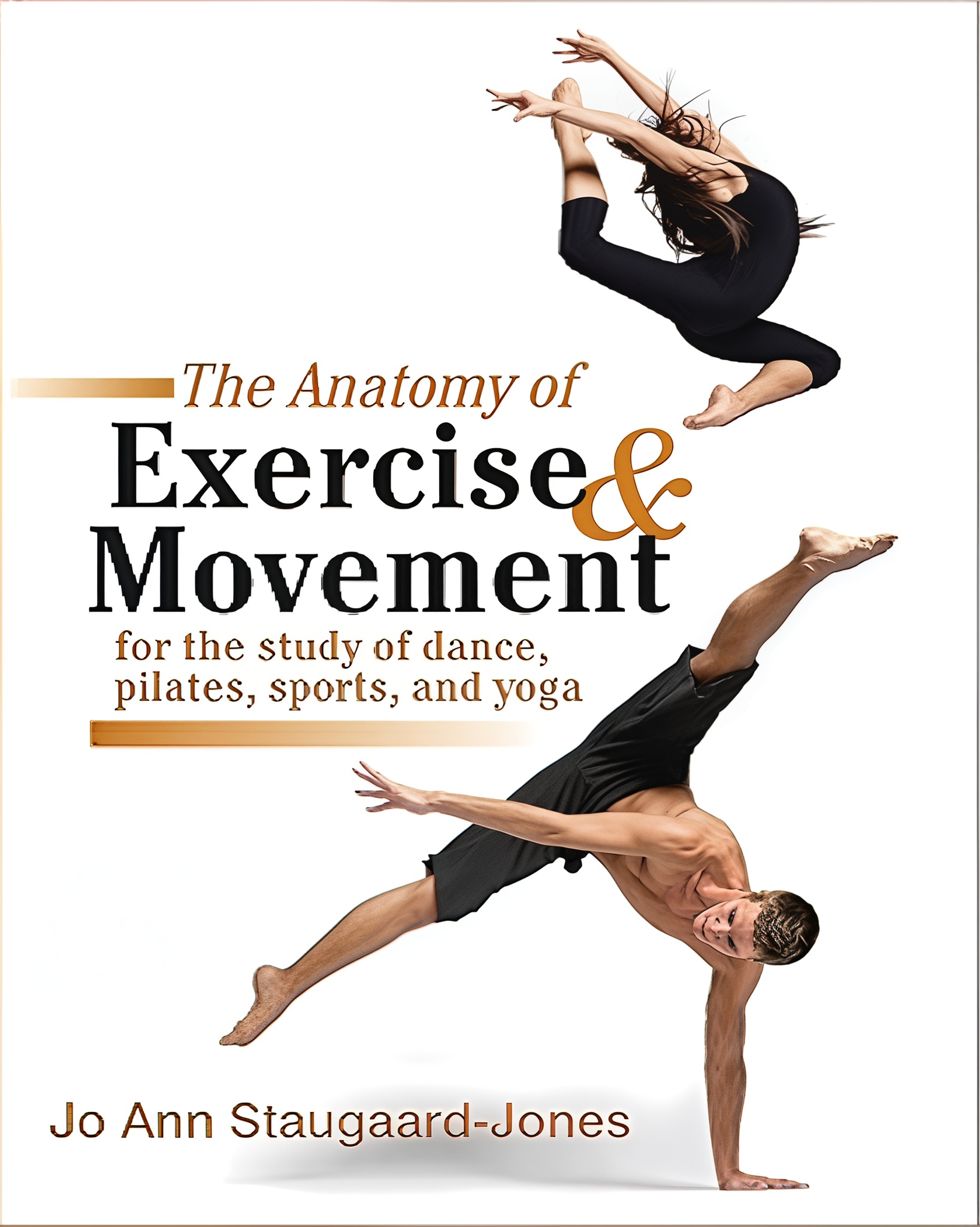
Awareness of movement potential,” says author Jo Ann Staugaard-Jones, “is key to a healthy body and injury prevention.” The Anatomy of Exercise & Movement shows readers how to gain that awareness by understanding the biomechanics of movement. In ten chapters, color-coded for easy reference, the author covers all of the major muscle and joint areas, including the spine; core region; shoulder; elbow; wrist and hand; and hip, knee, and ankle/foot joints. Most importantly, each chapter contains strengthening and stretching exercises for all of the above areas.
Developed as a handbook, The Anatomy of Exercise & Movement is an accessible resource for anyone who would like to know more about his or her body, how it moves, and what can be done to improve that movement. The more than 275 high-quality, four-color anatomical drawings and the broad scope of muscle and joint groups make this one of the most important guides to the moving body on the market. A helpful “Myths” page at the end of each chapter debunks many of the misunderstandings and rumors about fitness that have circulated over the years.



“Since [the Deltoid] is so visible, it is a popular muscle in the weight room.”
makes this a rarity…a very readable reference book.
This reference work assumes no prior knowledge of the intricacies of bones, muscles and other soft tissues, nor even of common definitions when dealing with the musculo-skeletal system, so opens with definitions and illustrations in order that the following discussions will be understandable. I found the first two chapters to be a useful review of the medical terms used in describing the body and the movements of limbs.
My next step was to flip through each of the “Myths” sections of the remaining chapters. Staugaard-Jones obviously has some pet peeves, a few of which are listed in these chapters. However, the tone is not one of exasperation, but rather of concern that her work will be useful and helpful. This tone resonates throughout the book.
After that, I reviewed the ‘Shoulders’ and the ‘Hips’ sections, as they are relevant to my body. Hmmm…I believe I’ll modify some of the things I have been doing.
I then started over and began to appreciate how the book would be used in classes. I must state up front, that having no medical training, I am not allowed to diagnose. However, I can certainly ask all the questions I need of a student presenting a complaint in order to fully understand the parameters of the complaint. This will include pulling out this book, turning to the relevant section, and discussing the complaint with the student, while we both look at the excellent illustrations.
This book will be my short list of books to always have at hand at class.