
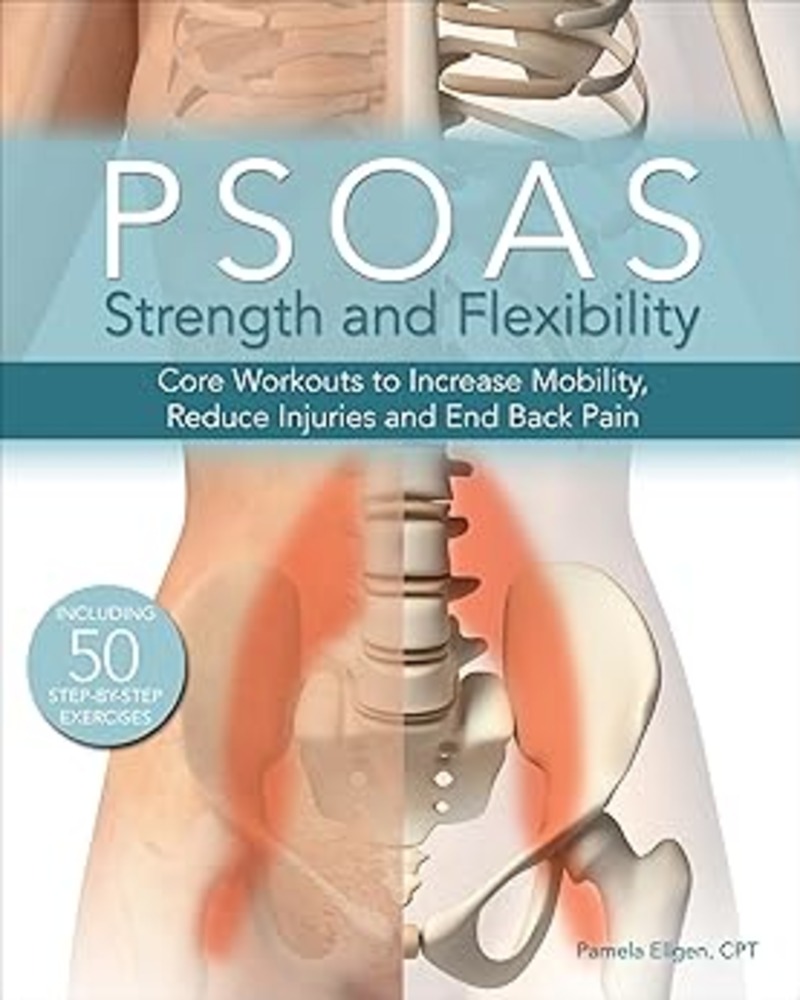
Fifty step-by-step exercises to help you prevent back and hip injuries by strengthening the muscle group connecting your upper and lower body.
Connecting the lower spine to the hips and legs, a strong and flexible psoas muscle is vital for everyday movements like walking, bending and reaching, as well as athletic endeavors like jumping for a ball, holding a yoga pose and swinging a golf club. With targeted information and exercises, this book’s step-by-step program guarantees you’ll transform this vulnerable muscle, plus:
- Develop a powerful core
- End back pain
- Increase range of motion
- Improve posture
- Prevent strains and injuries
Packed with 100s of step-by-step photos and clear, concise instructions, Psoas Strength and Flexibility features workouts for toning the muscle as well as rehabbing from injury. And each program is based on simple matwork exercises that require minimal or no equipment.


and a good set of workouts....
Mina Perry
The book begins with a simple test of your psoas muscles strength and flexibility. There is a simple stretch, outlined in the book, to see how much you can stretch these puppies (mine were pretty tight at first, but tend to limber up quickly). There is also a strength test, which simply amounts to standing with your back against a wall and raising one knee. My strength was okay, given the fact that I do a wide range of exercises already, but since taking these two tests my psoas have developed some.
So, what are the exercises and stretches like? The book is full of movements and exercises taken from yoga, pilates, and body-weight training. There are many poses and movements which stretch and strengthen these hip muscles, as well as the more typically exercised quads, hamstrings, and glutes.
I found this to be a very useful book. It's certainly worth working through this book is you're experiencing lower back pain, I think, as I've found the the more flexible and healthy/strong I am overall, the less my back is a problem.
The only problem I could see people having with this book is that it's geared toward folks who have quite a bit of fitness and range-of-motion already. If your back is really hurting you, taking up these stretches and movements is going to be a nightmare. You might have a slipped or bulging disk, for instance, at which point you need to be resting for several weeks -- not working your psoas muscles. So any reader will need to approach this as a workout book and take some caution if you're getting into this kind of a workout.
Despite having never heard of the Psoas (I guessed I missed that day in biology), I leafed through this book and found it very enlightening. The author clearly explains what the psoas is and how proper strength training with it can significantly help with back pain and core strength.
I found the books honesty and frank style very refreshing. It does not claim to be a total answer for all the body’s problems, and even points out some of the overstatements from other authors about the muscle. I love the section on complementary exercises that go beyond the psoas.
As someone who sits at a desk all day and commutes on a bus for 3 hours, I think this book has some great tips to reduce the strain on my back.